

If you find that the sewn thread is uneven, easy to break, or the fabric is wrinkled when using the garment hemming machine, it is very likely that the thread tension is not adjusted properly.
Don't worry, this article will teach you step by step to adjust the thread tension in the simplest and most straightforward way, so that the thread you sew out is neat and strong!
1. What is line tension?
You can think of "thread tension" as how tight the stitches are pulled.
Pull too tightly: the thread is easy to break, and the fabric will be wrinkled
Pull too loosely: the thread will be loose, the seams will not be firm, and it will be easy to fall apart
Pull just right: neat stitching, strong seams, flat and good-looking fabric
Therefore, adjusting the thread tension is a key step to make the stitching effect better!
2. What tools do you need to prepare?
Before you start tuning, have the following widgets ready to make your operation smoother:
A small screwdriver: Some machines need to use it to screw the tension adjustment knob
A pair of scissors: used to cut the stitches
A small piece of test fabric: preferably the kind of fabric you want to sew to test sew to see how it works.
When you're ready, you can start adjusting!
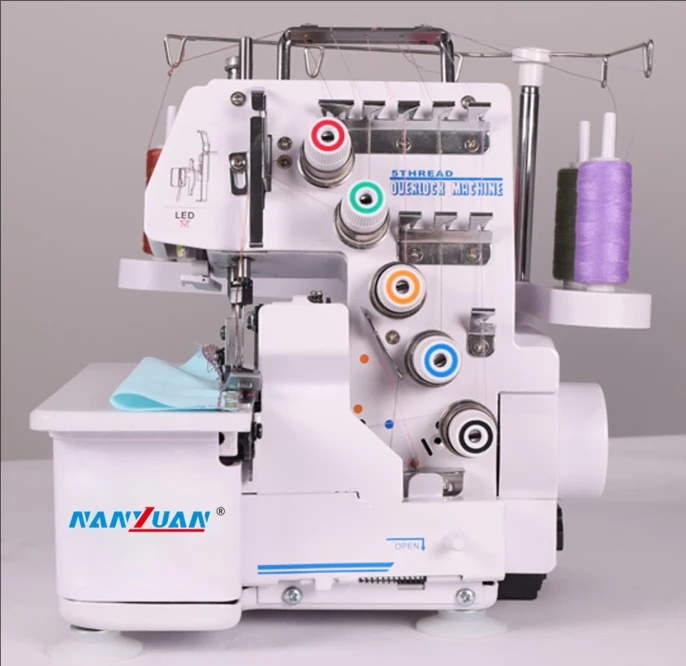

3. Teach you step by step to adjust the line tension
Step 1: Turn off the power first, safety first!
Turn off the power to the machine and unplug it
Remove the presser foot and needle plate for easy access to the tension disc.
Step 2: Locate the tension disc
The tension disc is usually located on the front or side of the machine, and there will be numbers or scales on it that represent different tension sizes.
Each line (top and bottom line) has its own tension disc, confirm which line you want to adjust.
Step 3: Test the current tension first
Put on the wire for the machine
Sew a few centimeters of thread on the test cloth
See the effect:
Is the thread too tight or too loose?
Is the fabric wrinkled?
Are the stitches neat and firm?
Step 4: Adjust the tension according to the situation
Thread is too tight or fabric wrinkles → Reduce tension (twist counterclockwise)
The thread is too loose or the seam is not firm → Increase the tension (twist clockwise)
Adjust only a little bit at a time (say 1/4 turn), then re-sew a piece of test thread to see the effect.
Step 5: Check if the stitches are balanced
The top line and bottom line should "shake hands" in the middle of the fabric, not too much to one side
The stitch should be straight and uniform
The seams should not be crooked
If it is unbalanced, you may need to adjust the tension of one of the threads again.
Step 6: Finally, test again
Sew a piece of thread of about 30 cm and see:
Whether the trace is stable at different speeds
Are there any broken wires or jumpers?
Is the fabric deformed?
If everything is normal, it means that the tension is adjusted!
Step 7: Put back the presser foot and needle plate
After confirming that there is no problem, put the presser foot and needle plate back on, and pay attention to installing and fixing them in place.
4. A few practical tips
Thin fabrics (such as silk, chiffon): Less tension should be used to prevent wrinkling of fabrics
Thick fabrics (such as denim, canvas): Tension should be higher to ensure secure stitching
Elastic fabrics (e.g. T-shirt fabrics): use medium tension with differential adjustment to prevent stretch deformation
Tips for daily maintenance:
Clean the tension disc once a week to prevent dust from affecting the tension
Replace worn parts regularly
Use good quality stitches to reduce thread breakage
5. Common problems and solutions
Problem Phenomenon Possible Causes Workaround
The stitch is too tight, the tension is too great, and the tension is adjusted counterclockwise
The fabric is wrinkled, the bottom line tension is too large, and the bottom line tension is reduced
Loose stitch Too little tension or incorrect threading Increase the tension Check if the threading is correct
The stitches are often broken The thread is too thin or too much tension Replace the thicker thread Check if the tension is appropriate
6. Recommended equipment (selected according to needs)
We offer several types of edge copier machines to suit different needs:
5-thread edge copying machine: suitable for garments that require high-strength stitching (such as sportswear)
Three-line edge copying machine: universal type, suitable for daily sewing
Electric edge copying machine: high efficiency, suitable for factory or mass production
If you are not sure which one to choose, please feel free to contact us, and we will recommend the most suitable machine according to your needs.
7. Summary
It is not difficult to adjust the thread tension of the garment edge copying machine, just remember:
Adjust a little bit each time
Test a few more times
Find the tension that best fits your current fabric and thread
With these in mind, you can easily sew professional-grade stitches!
Check out our 5 Thread Overlock Sewing Machine, 3 Thread Overlock Sewing Machine, and Electric Overlock Sewing Machine for more information.
If you still have questions?Feel free to contact our professional team, we will provide you with one-on-one technical support and equipment recommendation services.