

Introduction
In garment manufacturing terminology, many buyers and sewing operators frequently mix up lockstitch and straight stitch. Even on product listings for the birdnest lockstitch sewing machines, these two terms are often used interchangeably. However, they describe two completely different dimensions of sewing technology: lockstitch defines the stitch‑forming mechanism, while straight stitch describes stitch visual geometry and appearance. Understanding their distinction helps factories select the right industrial sewing equipment and evaluate the performance of anti‑birdnest flat‑seam machines such as the GS‑1968Max.
What Is Lockstitch
Lockstitch is a fundamental stitch‑forming principle for industrial flat‑seam machines (ISO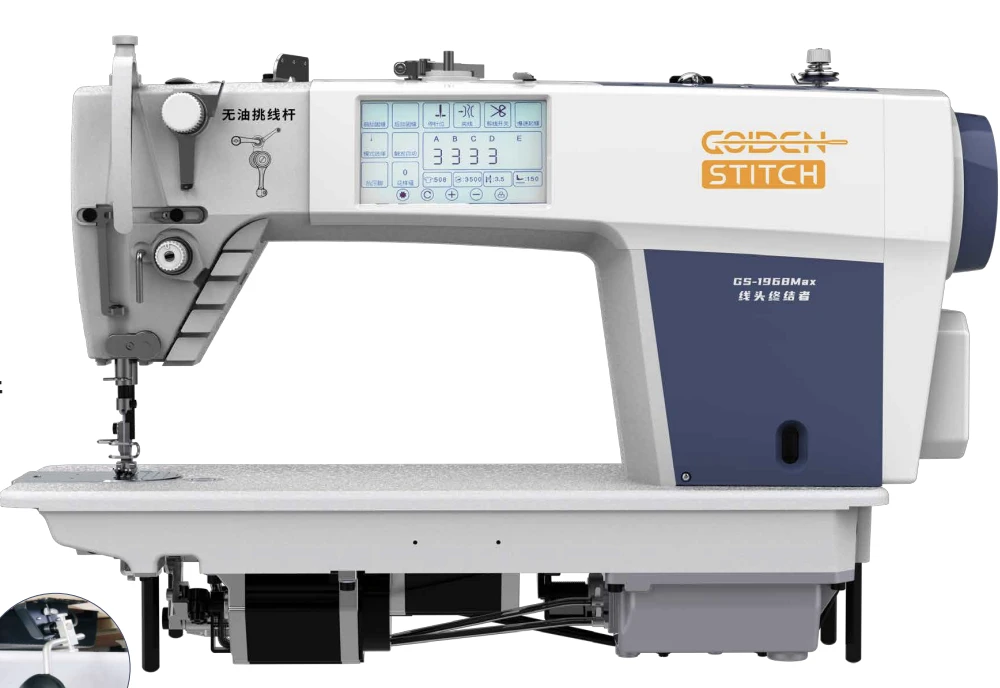 stitch class 301). It works with two independent threads: upper needle thread and bobbin thread. When the needle penetrates fabric and rises, the rotary hook catches the needle‑thread loop and wraps it around bobbin thread. The two threads interlock firmly inside fabric layers, creating tight, hard‑to‑unravel seams with identical appearance on both fabric front and reverse sides.
The birdnest lockstitch sewing machine GS‑1968Max adopts this classic lockstitch forming system, equipped with dual‑motor trimming and AI cloth‑thickness sensing to solve the well‑known "birdnest" defect: messy thread tangling accumulated on fabric back at sewing start. Birdnest phenomenon happens when excess needle‑thread tail gets locked inside fabric layers by lockstitch motion, forming knotted thread balls that require manual trimming and reduce finished‑product yield. By optimizing trimming logic, the machine controls start thread tail to approx.3.5 mm and ending thread tail to approx.2.5 mm, eliminating birdnest without extra external fixtures.
What Is Straight Stitch
Straight stitch refers to the visual outcome: stitches arranged in a continuous straight line, no lateral needle swing during feeding movement.
Straight stitch is most commonly produced via lockstitch mechanism. But important to note:
- Lockstitch machines can output non‑straight stitches (zig‑zag, pattern stitches) while still belonging to lock‑interlock stitch class.
- Very few non‑lockstitch mechanisms may also produce visually straight lines (certain chain‑stitch variants), yet they are not lockstitch because there is no top‑bobbin thread interlocking inside material.
| Item | Lockstitch | Straight Stitch |
|---|---|---|
| Nature | Stitch‑forming mechanism | Visual stitch shape |
| Core feature |
Upper thread & bobbin thread interlock inside fabric |
Needle moves only forward/backward, zero side‑swing |
| Possible stitch shapes |
Straight, zig‑zag, decorative pattern |
Only straight‑line seam |
| Typical machine |
Industrial lockstitch flat‑seam machine |
Straight‑stitch mode of lockstitch machine |
Practical Implications for Birdnest Lockstitch Sewing Machine Users
Many customers inquire: "If this is a lockstitch machine, can it do straight‑stitch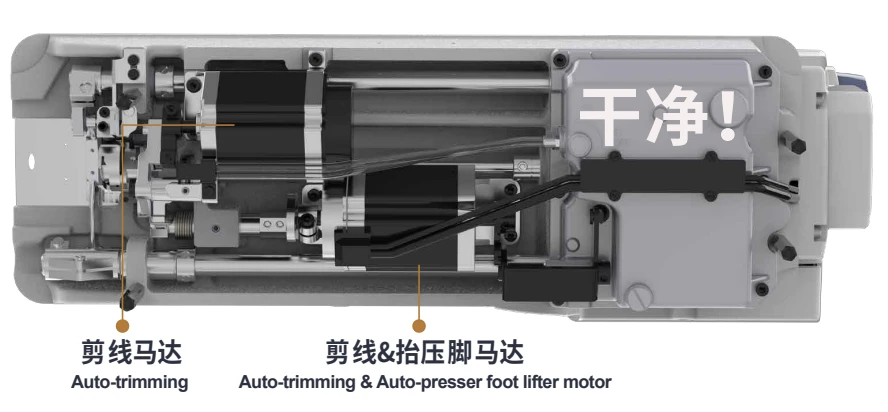 seams for garment assembly?" The answer is yes. The GS‑1968Max birdnest lockstitch sewing machine uses lock‑interlock mechanism as its foundation. When lateral needle swing is disabled, it outputs standard straight lockstitch for garment piecing, home‑textile sewing and sportswear production, supporting stitch‑length adjustment 0‑6 mm and maximum speed up to 5000 RPM.
Besides standard straight‑lock seams, its built‑in 8 pattern‑stitch modes still rely on lockstitch principle for bartack and reinforcement stitching, even though those stitches are not visually straight lines.
Why This Distinction Matters For Production
- Machine purchasing: When sourcing flat‑seam equipment, confirm whether you require lockstitch‑based mechanical performance, or only visually straight seams. Lockstitch delivers far superior seam durability versus chain‑stitch alternatives for woven fabrics (cotton, linen, satin, medium‑thin denim) that GS‑1968Max targets.
- Birdnest defect comprehension: Birdnest‑thread‑ball defect specifically occurs on lockstitch machines. The inter‑locking action pulls loose starting thread tails underneath fabric. This defect does not manifest identically on chain‑stitch machines, so anti‑birdnest technical solutions are developed for lockstitch flat‑seam equipment.
- Parameter debugging: On birdnest‑free lockstitch equipment, anti‑birdnest trimming function works for both straight‑stitch and pattern‑stitch lock‑seams, removing messy start‑sewing thread tangling across multiple stitch modes.
Conclusion
Lockstitch and straight stitch are not interchangeable terms. Lockstitch describes how stitches are made; straight stitch describes what stitches look like. A birdnest lockstitch sewing machine such as GS‑1968Max is built around lock‑interlock stitch mechanics. It excels at producing high‑quality straight lock‑stitches for mass‑volume garment and home‑textile production, meanwhile it can generate other lock‑based decorative stitches. Its anti‑birdnest dual‑motor‑trimming system solves the classic lockstitch machine pain point of thread‑ball accumulation at sewing start, cutting manual‑trimming labor costs and improving finished‑seam quality.
Zhejiang Nanyuan Sewing Equipment Co., Ltd. is a professional industrial sewing machine manufacturer and exporter, specializing in independent R&D and production of high‑performance Birdnest Lockstitch Sewing Machine. Focusing on efficient, stable and zero‑defect sewing solutions, the factory delivers cost‑effective sewing equipment for global textile and garment manufacturers.